
POSSESSIVES:
Who Does It Belong To?
Possessives show ownership or belonging. They tell us who something belongs to.
- My book - the book belongs to me
- Your bag - the bag belongs to you
- His car - the car belongs to him
- Her phone - the phone belongs to her
- Our classroom - the classroom belongs to us
- Their house - the house belongs to them
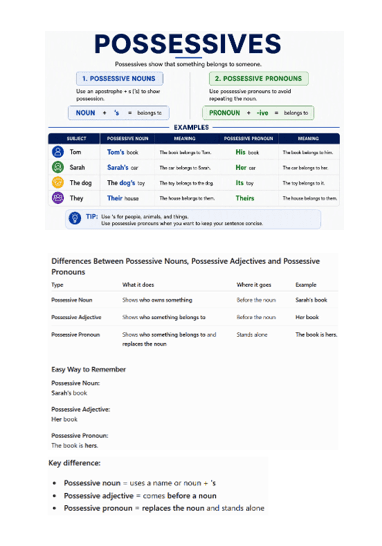
1. Possessive Nouns
Definition: A possessive noun shows that something belongs to someone or something.
Examples:
Sarah's book = the book belongs to Sarah.
John's car = the car belongs to John.
The dog's tail = the tail belongs to the dog.
Remember: We usually add 's to a singular noun to show possession.
2. Possessive Pronouns
Definition: A possessive pronoun shows who something belongs to and replaces the noun.
Examples:
This book is mine. = The book belongs to me.
This bag is hers. = The bag belongs to her.
That car is his. = The car belongs to him.
These toys are theirs. = The toys belong to them.
Possessive pronouns:
mine, yours, his, hers, ours, theirs
Key difference:
Possessive noun: Sarah's book
Possessive pronoun: The book is hers.
3. Possessive Adjectives
Understanding Possessive Adjectives Step by Step
Definition: Possessive adjectives are words that show who something belongs to. They are used before a noun.
To understand this, follow these three steps:
Step 1: Find the person or thing that owns something. First, identify who has or owns the object.
Example:
Sarah has a cat. Who has the cat?
Sarah has the cat.
Step 2: Replace the person's name with a possessive adjective. Instead of repeating the person's name, we can use a possessive adjective.
For Sarah, we use her because Sarah is a female name. Sarah → her
Step 3: Put the possessive adjective before the noun. The possessive adjective comes before the thing that belongs to the person.
How to Use Possessive Adjectives
The possessive adjective comes before the noun and shows who it belongs to.
Example 1: Sarah has a cat.
Sarah is female, so we use her.
Sarah → her
Sarah's cat → her cat
→ This is her cat.
Example 2: John has a book.
John is male, so we use his.
John → his
John's book → his book
→ This is his book.
Example 3: The children have toys.
The children are a group, so we use their.
The children → their
The children's toys → their toys
→ These are their toys.
The word their tells us that the toys belong to the children.
The Main Idea
Think of a possessive adjective as answering the question:
"Who does it belong to?"
my = belongs to me
your = belongs to you
his = belongs to him
her = belongs to her
its = belongs to an animal or thing
our = belongs to us
their = belongs to them
A Useful Pattern
Person + object → Possessive adjective + object
For example:
Sarah + cat → her cat
John + book → his book
The children + toys → their toys
The possessive adjective must come before the noun:
her cat
his book
their toys
This is why we call my, your, his, her, its, our, and their possessive adjectives.

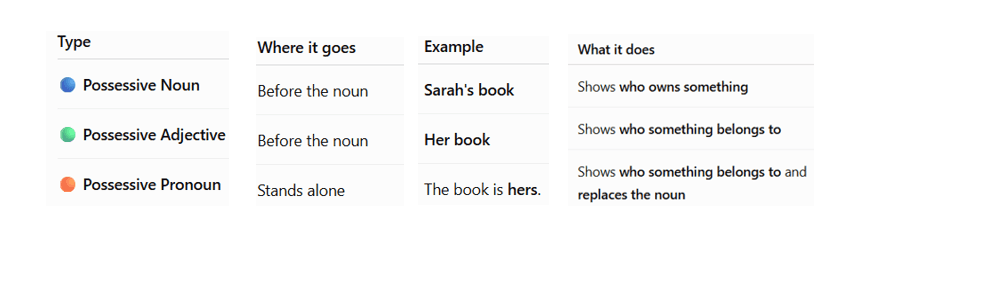
Differences Between Possessive Nouns, Possessive Adjectives and Possessive Pronouns
Easy Way to Remember - Possessive Noun: Sarah's book. Possessive Adjective: Her book. Possessive Pronoun: The book is hers.
Showing Ownership in English
Possessive Questions
Possessive questions ask who owns something or who something belongs to..
1. Whose...?  Asks who owns something.
Whose bag is this?
2. Who has...?  Asks who has something.
Who has the keys?
3. Do/Does - have...?  Asks if someone has or owns something.
Do you have a car?
Does she have a laptop?
4. Is/Are ... yours?  Asks if something belongs to someone.
Is this yours?
Are these theirs?